
Free Electrical Calculation Software, Offline in Your Pocket
Download all 12 Voltix calculators - cable sizing, voltage drop, breaker sizing, conduit fill and more - and run them on site with no signal. Free on Android, iOS coming soon.
What electrical calculation software has to get right
Every cable calculation, in any standard, comes down to three independent checks, and a conductor has to pass all three. It must carry the design current without exceeding its insulation temperature. It must keep voltage at the load inside the permitted drop. And the protective device must clear a fault before the conductor reaches its adiabatic limit.
Software earns its place on the second and third of those. The first is a table lookup you could do by hand. The other two are repetitive arithmetic with correction factors stacked on top of each other, done at the end of a long day, usually on a phone. That is where errors come from, and it is the part worth automating.
The calculators
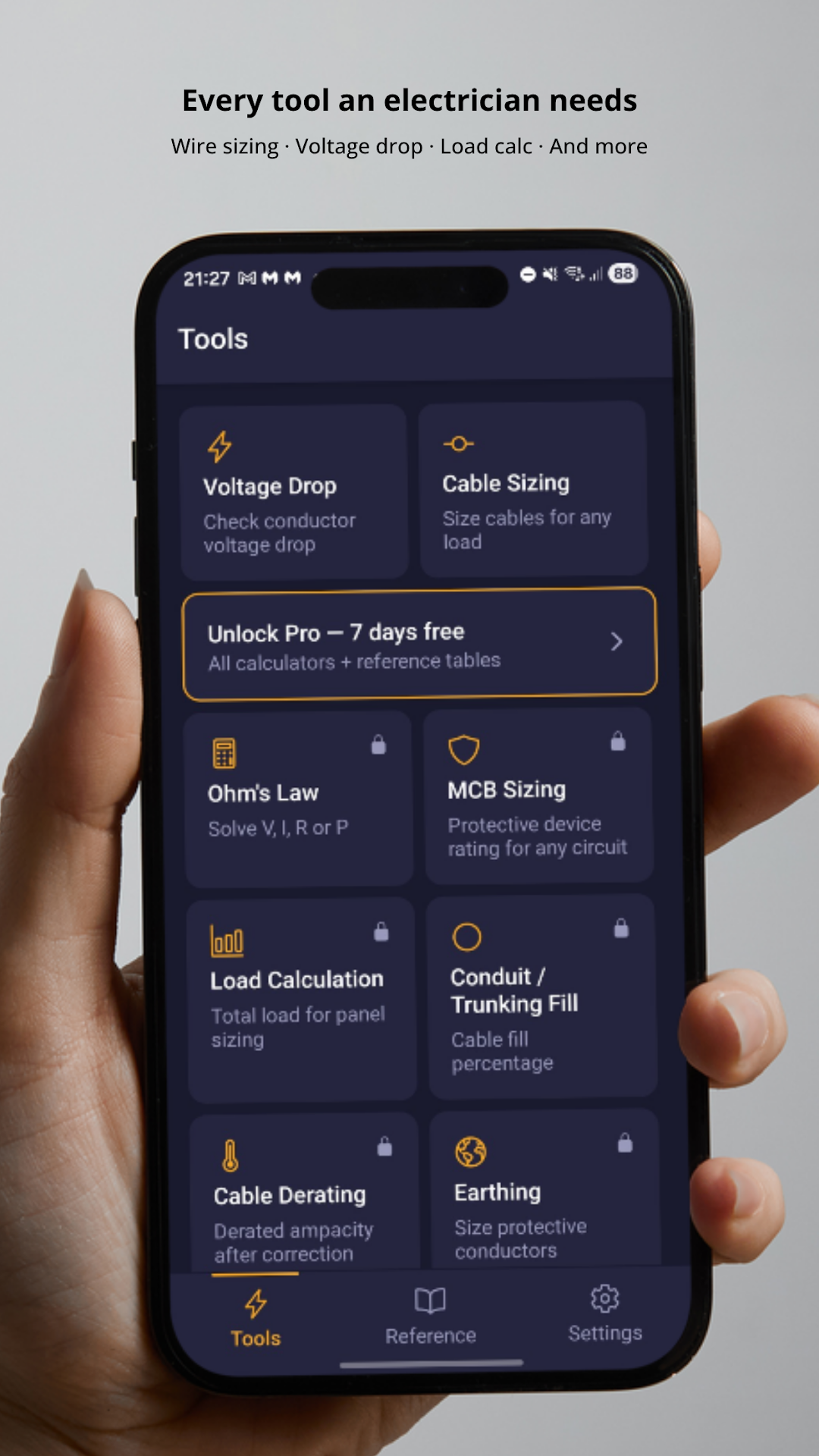
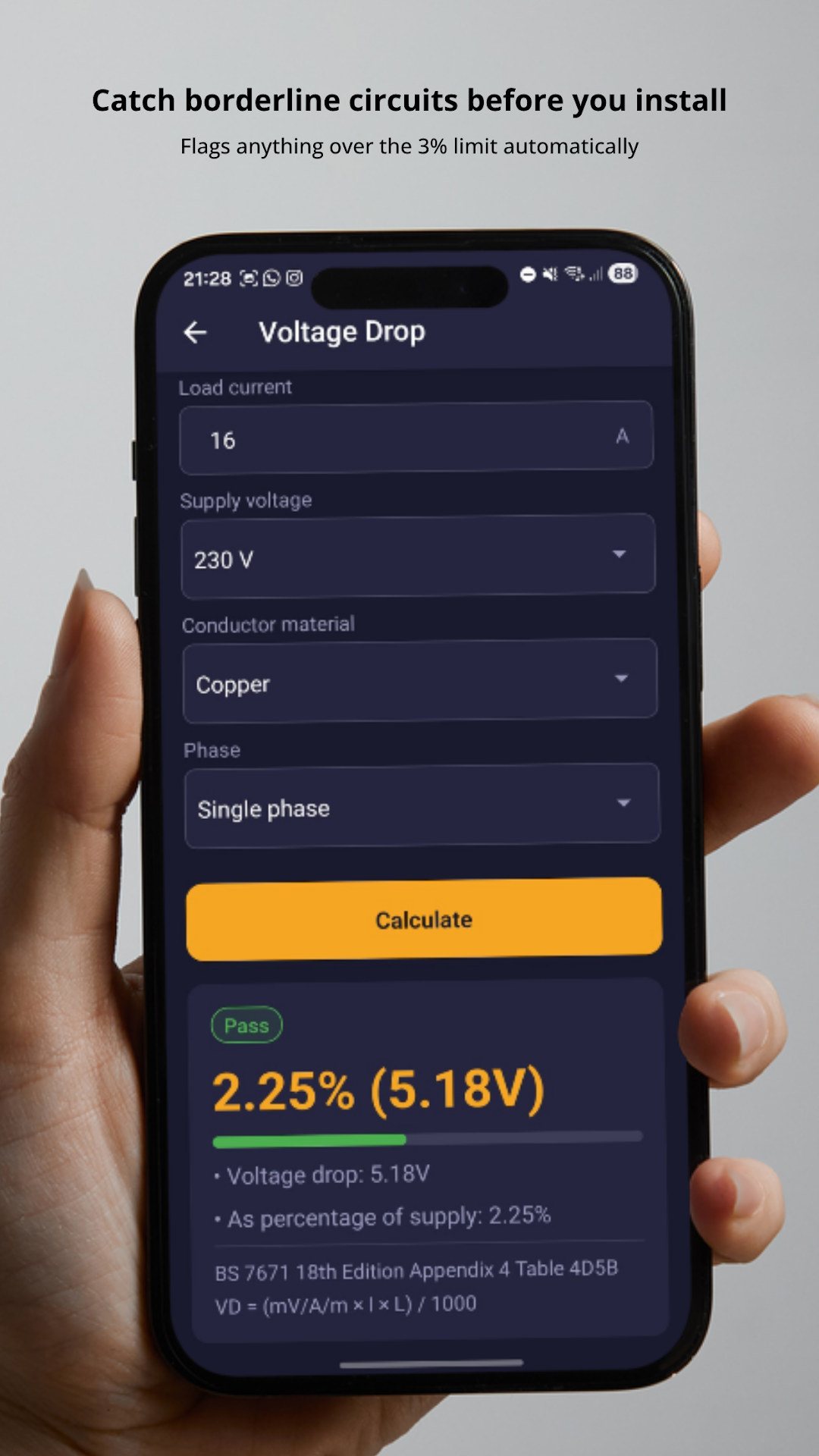
- Voltage drop — Single and three phase drop over a run, against the 3% and 5% limits.
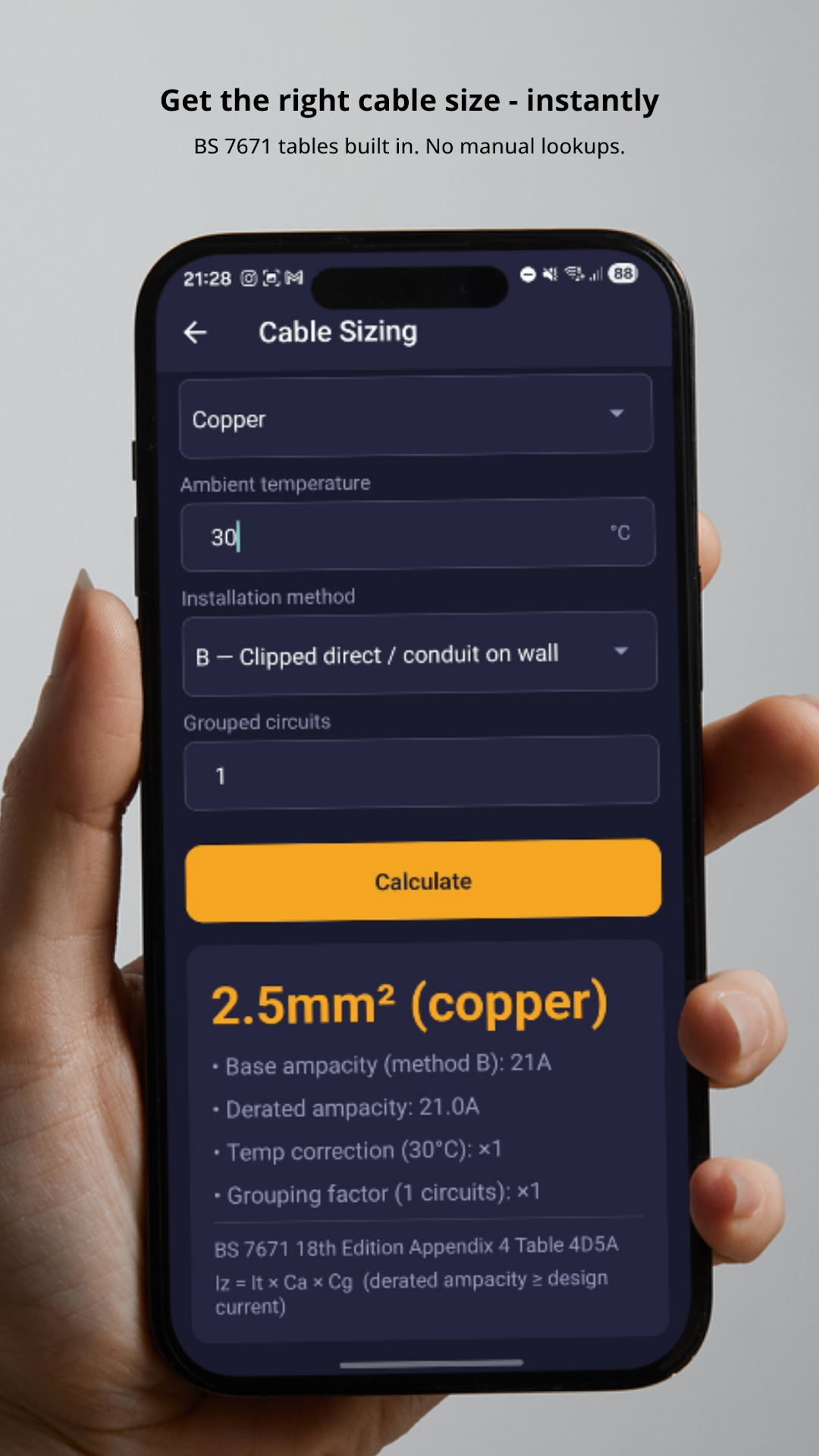
- Cable sizing — Conductor size from design current, install method and length, to BS 7671.
- Cable derating — Grouping, ambient temperature and insulation correction factors applied together.
- Circuit breaker size — Protective device rating from load, with the In ≥ Ib ≥ Iz coordination check.
- Earthing and grounding — Protective and earthing conductor sizing across BS 7671, NEC and AS/NZS.
- Electrical load — Service and feeder load to NEC Article 220.
- Conduit fill — Permitted conductor count for a given conduit, to NEC Chapter 9.
- Wire size (NEC) — Ampacity-based conductor selection to NEC 310.16.
- Wire gauge (AWG) — AWG to mm² conversion and the reverse.
- Ohm’s law — Voltage, current, resistance and power, solved from any two.
All of them run in the browser with no account and no trial period. The Android app carries the same engines plus reference tables, and works with no signal.
A worked example, and the mistake software prevents
Take a 20 A radial in 2.5 mm² copper, 25 m long, single phase at 230 V. The voltage drop calculation is simple enough:
Vd = (mV/A/m × Ib × L) ÷ 1000
The trap is the resistance figure. Conductor resistance rises with temperature, and a cable running at its rated load sits near 70 °C, not at the 20 °C at which resistance is usually quoted. For copper, resistance climbs by about 0.393% per degree, so 50 °C of rise adds nearly 20%.
Run the same circuit both ways:
- Using 20 °C resistance: 6.90 V, exactly 3.00%. Comfortably inside the 5% limit, and it even scrapes the 3% lighting limit.
- Using 70 °C resistance: 8.25 V, 3.59%. Still passes at 5%, but it now fails a 3% limit outright.
Working cold understates the drop by 16.4%. On this circuit that is the difference between a lighting design that passes and one that does not, and nothing about the wrong answer looks wrong.
The same circuit at 20 A reaches the 5% limit at 34.8 m and the 3% limit at 20.9 m. A 1.5 mm² lighting circuit at 6 A runs to 41.8 m before it hits 3%. Those are the numbers worth carrying in your head; the calculator is for everything in between.
Conductor resistance and millivolt drop, from first principles
Computed from the resistivity of annealed copper, 1.7241 × 10⁻⁸ Ω·m at 20 °C, with a temperature coefficient of 0.00393 per °C. Single-phase figures assume two conductors, three-phase uses the √3 line relationship.
| CSA (mm²) | mΩ/m @ 20 °C | mΩ/m @ 70 °C | mV/A/m, 1 ph | mV/A/m, 3 ph |
|---|---|---|---|---|
| 1.0 | 17.24 | 20.63 | 41.26 | 35.73 |
| 1.5 | 11.49 | 13.75 | 27.51 | 23.82 |
| 2.5 | 6.90 | 8.25 | 16.50 | 14.29 |
| 4.0 | 4.31 | 5.16 | 10.31 | 8.93 |
| 6.0 | 2.87 | 3.44 | 6.88 | 5.95 |
| 10.0 | 1.72 | 2.06 | 4.13 | 3.57 |
| 16.0 | 1.08 | 1.29 | 2.58 | 2.23 |
Read this as physics, not as a design table. These are ideal-conductor figures. BS 7671 tabulates slightly higher millivolt drops for the same sizes, because the published values account for stranding, cross-sectional tolerance and installation effects that pure resistivity ignores. Design from the tabulated values in the standard. The point of this table is to show you where those numbers come from and roughly what to expect, so an answer that is wildly out is obvious to you.
Download, or just run it in a browser?
Most people searching for electrical calculation software to download do not actually want an installer. They want something that works, costs nothing, and does not demand a licence key. Being direct about the options:
- Browser, free, no account. Every calculator on this site. Best on a desktop when you are doing a design at the bench.
- Android app, free tier plus Pro. The right choice if you need calculations in a plant room or a new build with no signal. It runs fully offline once installed.
- Full commercial design packages. Genuine desktop software for whole installation design, schedules and certification. Real tools, but priced accordingly, and the free downloads advertised for them are usually time-limited trials.
If you need distribution board schedules and certification output, buy the commercial package. If you need to check a cable size, a drop or a breaker rating quickly and correctly, you do not need an install at all.
Further reading: BS 7671 cable sizing, step by step, voltage drop explained and cable derating factors.
Everything in the app
- 12 professional calculators
- Works fully offline - no signal needed on site
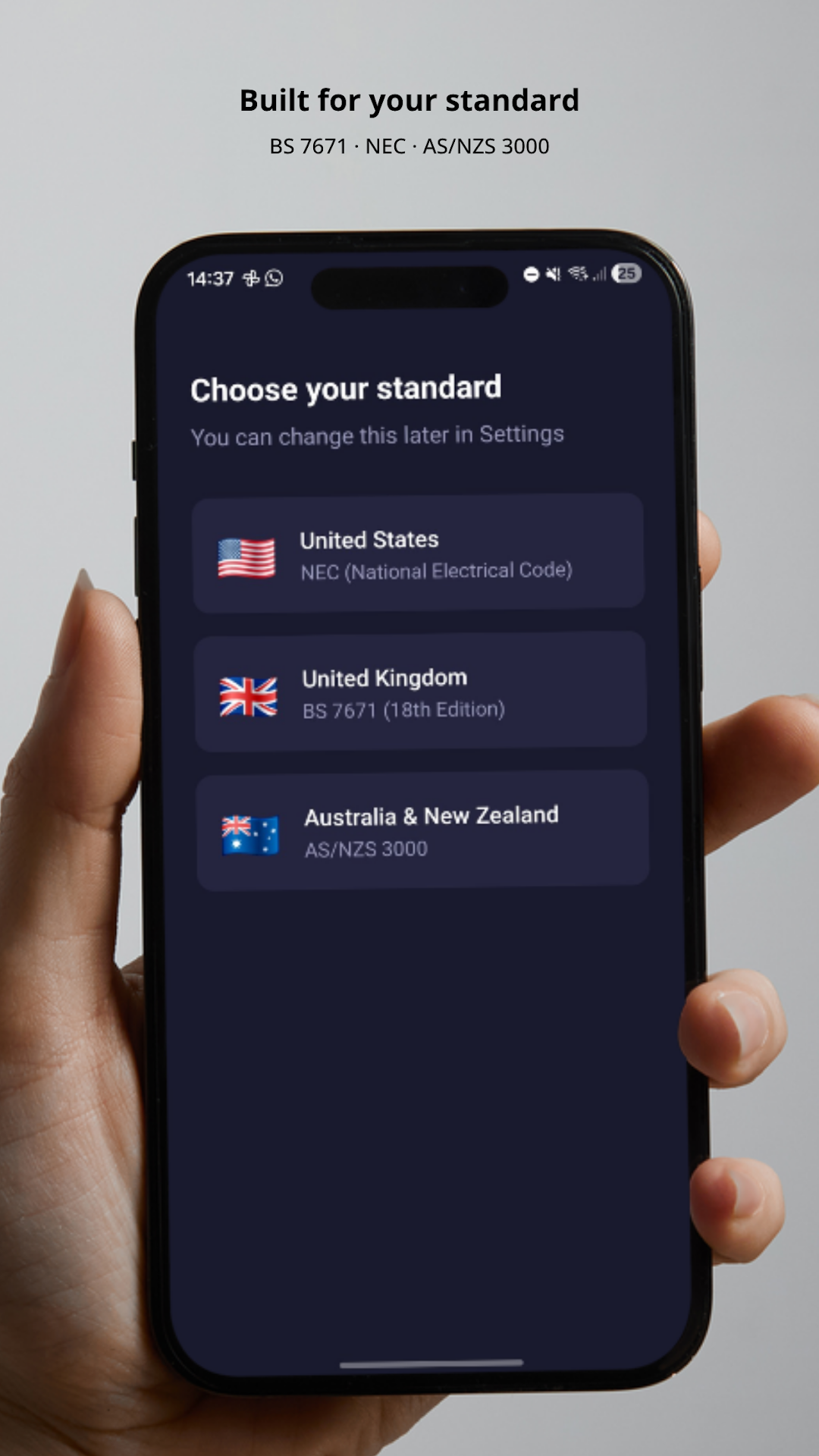
- NEC, BS 7671 & AS/NZS standards
- Built-in reference tables
- Free core calculators, forever
- No account required, no data collected
Free
Always free
$0
- Voltage drop
- Wire / cable sizing
- Ohm's law
Pro
Full toolkit
$4.99 /mo
or $29.99 / year
- All 12 calculators
- Reference tables
- Save & compare results
See it in action
Frequently Asked Questions
- Is there genuinely free electrical calculation software?
- Yes. Every calculator on this website runs free in a browser with no account and no trial period. The Android app is also free, with three calculators in the free tier and the full set on Pro. Most desktop electrical design packages are paid, and the free downloads you will find are usually time-limited trials of commercial software.
- Do I need to download anything to do cable calculations?
- No. The web calculators need no install. Download the Android app only if you work in plant rooms, basements or new-build sites where there is no mobile signal, because the app runs fully offline once installed.
- Does it do BS 7671 cable calculations?
- Yes. Cable sizing, voltage drop, derating and protective conductor sizing all support BS 7671, alongside NEC and AS/NZS. You still need a copy of BS 7671 for the tabulated current-carrying capacities, which are copyright of the IET and are not reproduced here.
- Is there a Windows or Mac desktop download?
- Not currently. The web calculators run in any desktop browser, which covers the same need without an install or a licence. A native Android app exists for offline site work and iOS is in progress.
- Can I rely on the output for a design that gets certified?
- The calculators are a check, not a substitute for the standard or for a competent designer. Verify results against BS 7671, the NEC or AS/NZS 3000 as applicable before issuing a design or certificate.